Ideally, the cost of producing a fabricated part should converge toward the cost of the raw materials, energy, and consumables required to make it.
Today, it is often many times higher. What if we could collapse the difference?
Somewhere in Pittsburgh, it is the middle of the night and the lights are off. A sheet of steel leaves the rack. A Magician cuts it and sorts the blanks. A Bender forms the edges. Minutes later, a finished server rack panel is stacked and waiting to ship — and no one has touched it.
No one quoted it either. The customer uploaded a CAD file, saw a price in seconds, and pressed order. No emails, no site visits, no minimum quantities. The parts arrive in days.
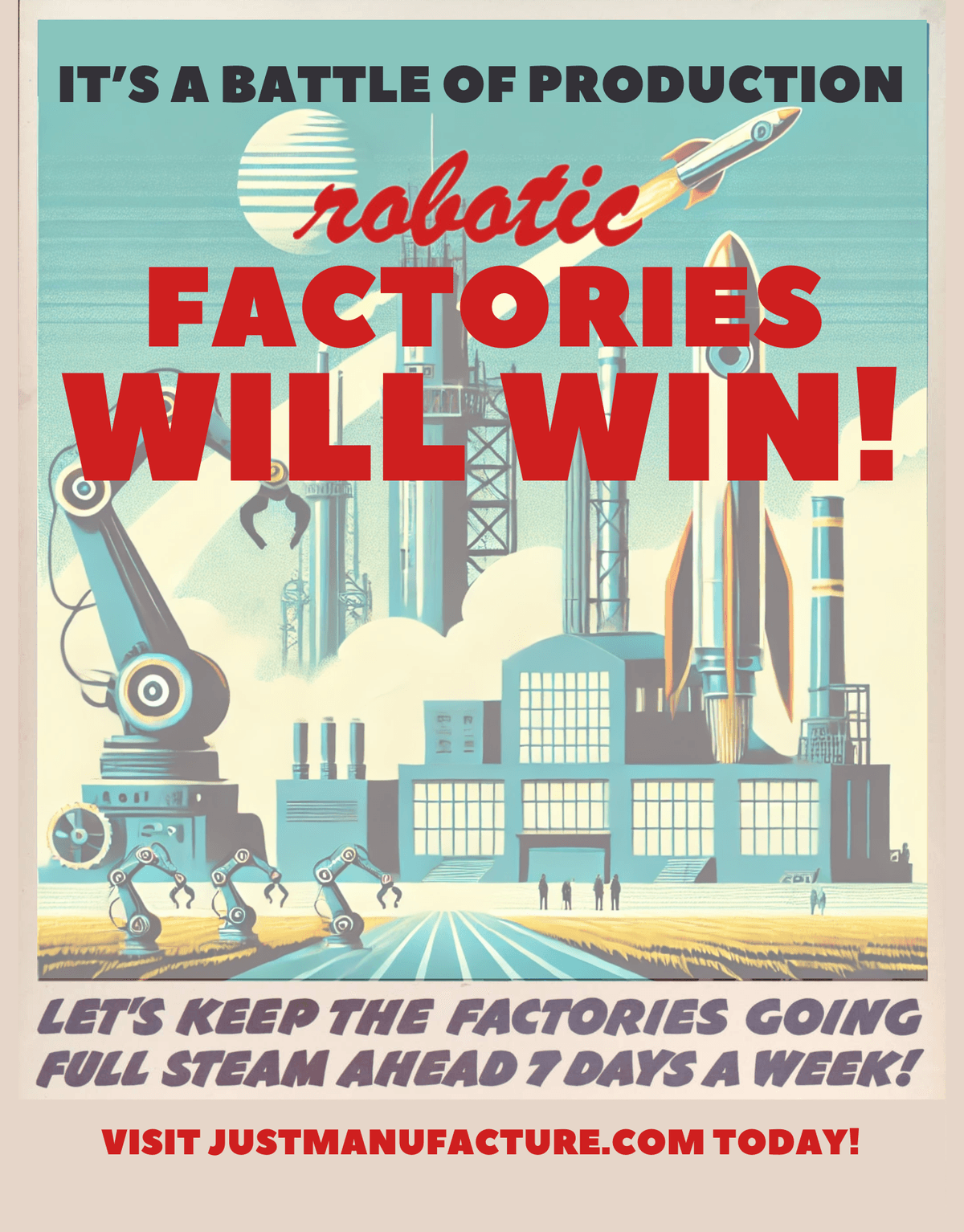
This is a dark factory — lights off, doors closed, robots running around the clock. In a conventional shop, most of what you pay for is people — quoting, programming, setup, loading, operating, inspecting. Take the people out of the process, and the price of a part falls toward its floor: the metal, the energy, and the consumables.
In the early days of electrification, factories that wanted power built their own plants — boilers, engines, a dynamo, and a crew to tend them. There was no secret to it; any factory with capital could do the same. The central station won anyway: a shared plant serving an entire city's diverse loads ran at utilization no single plant-owner could match, and its cost per kilowatt-hour fell relentlessly. Within a generation, owning a power plant went from standard practice to a liability.
Owning fabrication equipment is next. Send a CAD file, receive finished parts — no machines to buy, no machine time to book. xLogic is the central station for fabricated metal.
Any shop can make the same part — just as any factory could make its own power. That is the point, not the problem. In a commodity capability, the winner is whoever's cost curve falls fastest. Ours falls with every robot we build, every fab-stack we deploy, and every customer who raises utilization.
The grid had one limitation: it could only ever sell one product. Software is what lets us run the same economics on any part a customer can design.
Prototype or production run — we make manufacturing too cheap to meter, at production-grade quality.
At xLogic, a robot is not merely an arm bolted onto an old machine — it is the complete production system: process-specific hardware, motion, tooling, vision, material handling, and software, built together for autonomous, high-mix production.
Our robots deploy as fab-stacks: one Magician for cutting and sorting, plus the complete robotic crew downstream of it — bending, welding, hardware insertion, finishing, and material handling — turning raw sheet, tube, and plate into finished, ready-to-ship product with minimal human involvement.
Every robot in the stack is redesigned from scratch with automation-centricity in mind — fewer hand-offs by design. What takes a job shop 15 conventional machines and a crew of operators, one fab-stack is designed to do alone.
A complete fab-stack costs less than a single commercial laser cell.
We manufacture the robots, deploy them inside factories we own, and use software to make production effortless to configure and run.
We call it Dark Factories as a Service.
The War for Capacity
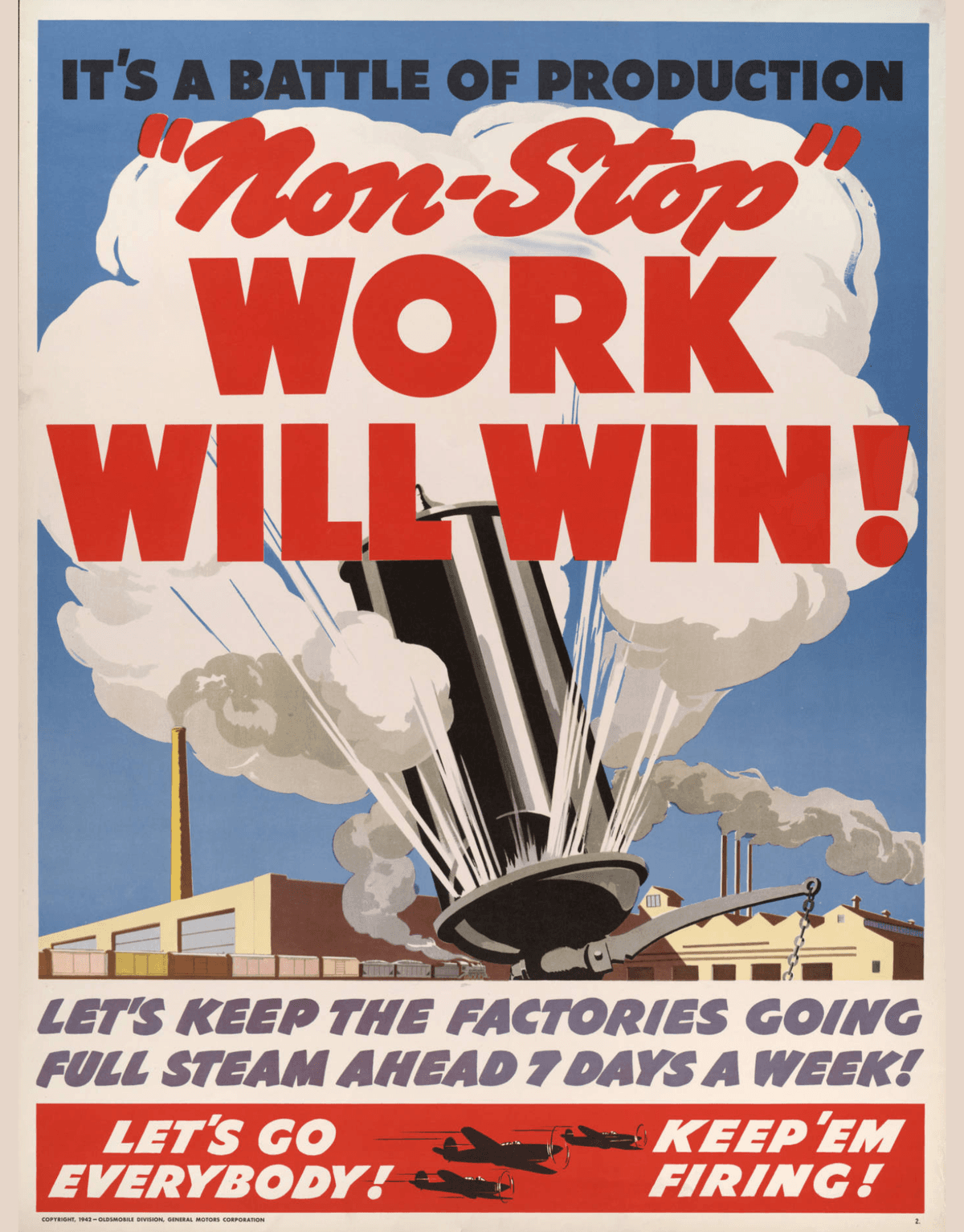
During World War II, America became the Arsenal of Democracy because it could convert advanced civilian capacity into war production. China now holds that advantage across civilian manufacturing, heavy industry, and critical upstream inputs.
Manufacturing — and therefore war — is decided by unit cost, replacement speed, and control of upstream inputs. Whoever makes things cheaper, faster, and without asking permission wins.
Every reshoring plan eventually encounters the same constraint: reshoring needs capacity, capacity needs labor, and American industrial labor is not scaling.
For the US to win, it must become exceptionally good at manufacturing civilian products again — not by recreating its labor-intensive industrial base, but by building around what America is already good at.
The Constraint Just Broke
What is the United States good at?
For decades, these advantages were often outweighed by the one factor America could not match: the cost and scale of offshore labor.
That constraint is beginning to break.
The first robotic arm I bought cost more than $50,000. Four years later, a robot with similar specifications costs approximately $5,000 — less than a year of a factory worker's wages in India.
Robotic arms are now a commodity. Software development is becoming faster and cheaper. What we do is classical robotics, vision, controls, and software applied modularly and really well to achieve the reliability, uptime, economics, and high-mix flexibility a factory requires.
As robotics costs fall, manufacturing can increasingly be won through capital, software, and energy rather than labor alone — a competition in which America is far better positioned.
Won't China Just Automate Too?
It will — and China will remain a manufacturing superpower.
Our thesis does not depend on China failing to automate. It depends on robots shrinking China's labor advantage until the cost of distance matters more.
When labor represents a large share of manufacturing cost (especially true for fabrication), China's lower wages, scale, and supplier ecosystem can outweigh the penalties of distance.
But when robots collapse the labor component, freight, lead times, inventory, tariffs, and coordination become a much larger share of the equation.
For fabricated metal, this matters enormously. Raw metal is dense and efficient to ship. Finished assemblies are often bulky, irregular, and mostly air.
If an American robotic factory can approach China's conversion cost, proximity can become decisive for bulky, high-mix, critical and time-sensitive products.
Fabrication often turns dense, efficiently packed metal into bulky and irregular structures, while freight is constrained by both container volume and weight.
A container may carry roughly 26 tonnes of densely packed raw sheet before reaching its weight limit. The same container may hold far fewer finished assemblies once that sheet has been formed, welded, and packaged into large, irregular geometries.
The container costs the same to move regardless of how efficiently its volume is used, and ocean freight alone can run into several thousand dollars before inland transport, duties, and handling.
Fabricate the metal before it crosses the ocean, and shipping can cost more than the steel.
Cheap labor opened the door, but China's supplier density, scale, infrastructure, capital, and industrial policy turned that advantage into an ecosystem. Reduce the labor gap, and proximity, lead time, capital availability, energy, and supply-chain resilience become far more important to the production decision.
Cheap labor was China's opening; scale, clusters, infrastructure, and industrial policy turned it into dominance. Robotics and software can be America's way back.
The Company-State
If xLogic were run by the CCP, how would it build China-like industrial capacity in America?
It would take what makes China exceptional at manufacturing — vertical integration, automation, long-term planning, and relentless attention to unit economics — and compress it into one company.
The pattern is not new. Bessemer turned skilled steelmaking into a machine process. Electrification stripped belts and shafts from factories. Ford turned craft production into the assembly line. Each shift moved work from labor into capital equipment, increasing output and collapsing the cost of everything downstream.
The closest company-level parallel is Ford's River Rouge. Ford controlled the production system around the Model T — coal from Fordson Coal, ore from the Imperial Mine, and rubber intended to come from Fordlândia — reducing its price from $850 to $260 in sixteen years.
But Ford built River Rouge to manufacture one product.
Unlike them, we build the system as infrastructure — giving anyone a Model T-like advantage for fabricated metal.
Like Ford and Musk, we pursue one objective: minimize the cost delta between raw material and finished goods as far as robotically possible.
Why fabricated metal? It is upstream of buildings, machinery, data centers, vehicles, energy infrastructure, process industries, and defense. There is no reindustrialization without it.
Ford River Rouge as Infrastructure
We turn this thesis into reality through two kinds of factories:
Builds the robots
Designs and manufactures xLogic robots. At its center sits The Flywheel — a flexible automated line designed to manufacture every robot in the xLogic network.
Exposes the capacity
A network of xLogic-owned factories containing thousands of those robots, turning customers' CAD files into finished, shipped parts on demand.
Why does industrial equipment cost millions today? Industrial-equipment prices contain layers of brand, distribution, integration, software, service, and supplier margin. xLogic builds for one customer — itself — allowing much of that cost to disappear. Over time, we will move deeper into the robot: actuators, drives, controllers, structures, tooling, and consumables.
That is how equipment costing hundreds of thousands or millions becomes an xLogic robot costing tens of thousands — a 10× or greater collapse in robot cost.
Customers do one thing: upload the CAD — and set their priorities across speed, quality, and cost. app.xlogic prices it in seconds. No MOQs, no quoting queue, parts in days.
A conventional shop takes 2–5 days just to quote — a human reads the drawing, plans it, prices it. We can deliver before competitors finish quoting. Any serious customer gets their first part free, because it costs us only machine time and material.
The software handles everything else required to turn that intent into production: process plans, fixtures, programs, robot configurations, and inspection.
Just as factories stopped generating their own power once the grid's economics won, manufacturers will stop owning fabrication equipment. At sufficient scale, buying and operating machines themselves no longer makes economic sense.
Philosophy
Why own the factories at all? Why design every robot ourselves instead of automating what already exists? Because we learned what happens when you do not.
Our experience includes 50 robots built from scratch at a previous company, 25+ combined deployments firsthand across different types of robotics, and a front-row seat to founders who deployed 250+ more. That experience revealed a structural problem.
Getting a robot to work 80% of the time is easy. The final 20% is a massive uphill battle. Customers expect near-perfect uptime, yet everything they provide was designed for human-led manufacturing — the parts, fixtures, workflows, equipment, and factory environment. Even when the task is identical, adapting the robot to each site can take months.
Robotics companies eventually spend more engineering time supporting geographically scattered deployments than improving the underlying robot. Every installation becomes a custom engineering project, and every lesson remains trapped at that site.
The problem was not the robot alone. It was the environment around it. As long as we deployed into factories designed for humans, reliable automation remained difficult and scaling required more engineers. To make robotic manufacturing reliable and scalable, we had to control both the robot and the factory.
That realization produced the four principles xLogic is built on:
Own the factories
Instead of adapting our robots to legacy environments, we build factories, fixtures, and workflows around autonomous production. Every improvement can then propagate across the entire network rather than dying in a one-off integration.
Choose the work
We select parts and customers suited to reliable robotic production instead of forcing robots to manufacture products and processes designed around human hands.
Design every robot ourselves
Integrate the robot, process, controls, and software around autonomous production.
Build in modular blocks
Reuse the same actuators, drives, controllers, structures, and software so each new robot becomes faster and cheaper to build.
Why hasn't anyone else tried our business model? Because every incumbent is structurally constrained: machine builders sell equipment, integrators deploy other companies' robots, traditional factories are not robotics companies, and marketplaces control no production.
Each inherits the costs and technical ceiling of the layer beneath it. xLogic owns the robot, factory, and software as one system — and profits when robots become cheaper.
What Has to Go Right
Our robots must match human cycle times, exceed human quality, and handle high-mix production with minimal intervention. The software must turn CAD into process plans, fixtures, programs, robot configurations, and inspection workflows almost effortlessly. We must also solve high-mix quality assurance and packaging.
Factories must remain highly utilized. Robot costs must continue falling as we build more of them. The user experience must make going from CAD to finished parts remarkably simple, and ordering from xLogic must beat owning the machines — on cost, speed, and quality.
These are difficult problems — and precisely why the opportunity is so large.
We have already proven parts of this across several processes. If we make the entire system work, every new robot improves the software, lowers costs, increases capacity, and makes the next customer easier to serve.
The Cost-Collapse
The United States is already relatively close to India on several fabrication inputs: metal, electricity, gases, and industrial land.
Labor is the only input catastrophically out of line. It is also the input xLogic is designed to remove.
Because we manufacture our own robots, an xLogic factory can target 5–10× more output per million dollars of capital expenditure than a modernized fabricator operating conventional equipment.
China built capacity ahead of demand using cheap, patient, state-backed capital. xLogic can pursue a similar outcome by making capacity inexpensive enough to build and hold.
Each fab-stack is a factory in a box. The network is the arsenal.
When electricity became abundant, nobody planned what followed — the appliances, the assembly lines, the industries built on the assumption that power was simply there. When compute became abundant, software ate the world. Abundance creates uses that scarcity never lets anyone imagine.
That is the unlock: fabrication that is simply there. An engineer goes from CAD to steel in days without owning a machine or waiting on a quote. A startup builds hardware with the supply chain of a giant. A builder designs what is best, not what is cheapest to procure. Iterating on physical products starts to feel like iterating on software.
As industrial capacity becomes cheaper and more abundant, products America struggles to manufacture affordably — housing, vehicles, energy infrastructure, shipbuilding, public infrastructure, and industrial equipment — come back within reach.
The Model T was not merely a car. It demonstrated what becomes possible when the cost of making something collapses.
xLogic is building the robot that makes that happen to everything.
The Answer
In 1941, America could become an arsenal because the factories already existed.
The next time capacity matters, the question will be the same: does it exist, and who owns the robots?
We are building so the answer is America — and the robots run themselves.
Ford built River Rouge to manufacture one product.
What begins as autonomous fabrication infrastructure can extend far beyond fabrication — into assembly and other manufacturing processes.
xLogic builds River Rouge as infrastructure.
Dark Factories as a Service.